
Racine County buyer guide
Racine County Homebuyer Flood-Risk Checklist
A flood-zone label is only one part of water-risk due diligence. Use maps, records, observations, insurance questions, and qualified professionals to understand a property before closing.
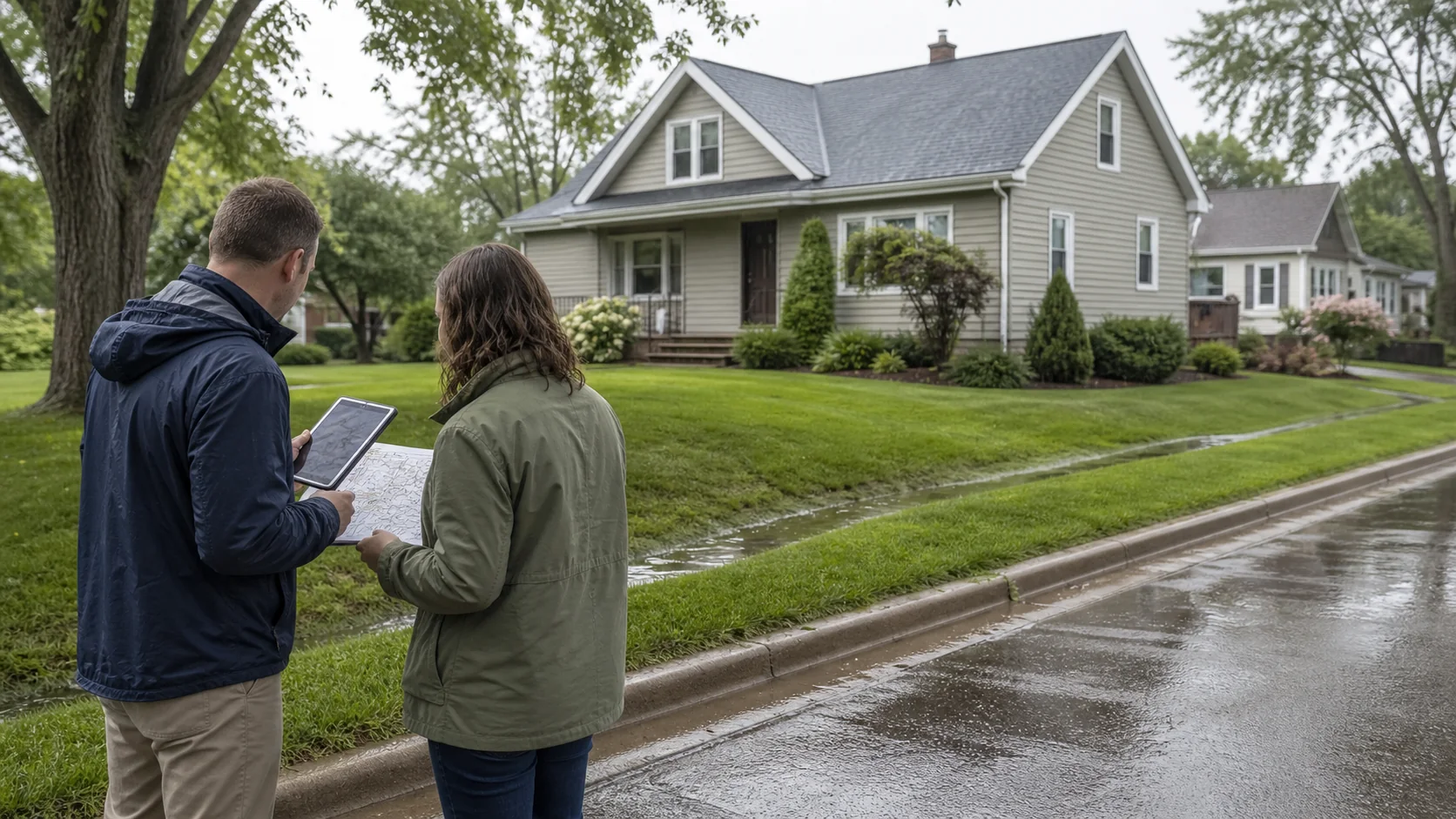
Water behaves differently from one property to the next. A home near Lake Michigan, the Root River, a tributary, a wetland, or low-lying ground may raise obvious questions, but drainage problems can also occur away from a mapped high-risk flood area. Buyers considering homes in the City of Racine, Mount Pleasant, Waterford, or elsewhere in Racine County should evaluate the specific parcel rather than relying on a neighborhood-wide assumption.
This checklist is meant to organize questions, not predict whether a home will flood. Official maps, local records, insurance professionals, inspectors, engineers, and legal advisers each answer different parts of the problem.
Start with the official flood map
Search the property's address in FEMA's Flood Map Service Center and identify the effective Flood Insurance Rate Map panel. Flood maps show flood zones, floodplain boundaries, and base flood elevation information where available. Save the map panel and any report you rely on so you can discuss the same document with the lender, insurer, municipality, and other professionals.
The Wisconsin Department of Natural Resources also offers a helpful floodplain mapping application, but it cautions that the FEMA layer displayed there is informational and is not the official map for regulatory decisions. Use the DNR tool to research an area, then use FEMA's effective map and the appropriate local zoning authority for property-specific determinations.
Do not translate “outside the high-risk zone” into “no risk”
A map designation is important, especially for lending and floodplain regulation, but it is not a warranty about future water. FEMA's National Flood Insurance Program says flooding can occur outside high-risk areas and that most homeowners insurance does not cover flood damage. Ask an insurance professional about coverage and price even when a lender does not require a flood policy.
Also separate river or lake flooding from other water concerns. Intense rain, poor grading, clogged drainage, sewer backup, groundwater, foundation seepage, or a failed sump system may involve different causes and different insurance coverage. Ask the insurer to explain exclusions, endorsements, deductibles, waiting periods, building coverage, and contents coverage in writing.
Walk the lot with drainage in mind
Visit after rain when possible. Look at the direction the ground slopes, where downspouts discharge, whether soil has settled near the foundation, and whether neighboring lots or streets send water toward the home. Note standing water, eroded soil, stained foundation walls, improvised drain extensions, unusually new basement finishes, multiple sump pumps, or landscaping that may redirect runoff.
These observations are prompts for more investigation, not proof of a defect. Seasonal conditions can hide or exaggerate clues. A qualified home inspector can evaluate visible conditions, while a drainage contractor, engineer, plumber, waterproofing specialist, or municipal official may be needed for a particular concern.
Review the basement and water-management systems
Ask the inspector to examine accessible foundation walls and floors, sump pits and pumps, discharge routing, floor drains, gutters, downspouts, grading, and visible drainage components. Confirm whether a sump pump has backup power and where it sends water. A pump that operates during the inspection only shows that it operated at that moment; it does not establish future performance.
For a finished basement, ask what is visible and what is concealed. Request permits and invoices for structural repairs, drain tile, waterproofing, sewer work, grading, or post-loss restoration. Consider how stored belongings, mechanical equipment, and finished space would be affected if water entered.
Ask for records and specific explanations
Read the seller's real estate condition report and follow up on disclosed water intrusion, flooding, drainage, foundation, sewer, or insurance issues. Ask for available repair invoices, warranties, permits, engineering reports, drainage plans, and claim-related documents the seller is permitted to provide. A vague answer such as “fixed years ago” is less useful than a written scope describing the cause and completed work.
Check the relevant municipality or Racine County department for available permits and zoning information. Responsibility may depend on whether the parcel is inside a city or village, in a town, and which agency administers the applicable ordinance. Do not assume the county is the correct office for every property.
Get an insurance answer before deadlines expire
Contact an insurance professional early enough to obtain a property-specific quote and clarify what information is needed. If a flood elevation or map determination is uncertain, ask whether an elevation certificate, survey, lender determination, or other documentation would help. Insurance cost and availability can affect the ownership budget even when the home price and mortgage payment seem comfortable.
The Wisconsin DNR notes that a standard National Flood Insurance Program policy generally has a waiting period, while an exception may apply when coverage is purchased in connection with a new home purchase. Confirm the timing and effective date with the insurer handling the actual policy; do not rely on a general article when coordinating closing.
Connect findings to the written offer
Flood and drainage questions may affect inspection, testing, document-review, insurance, financing, appraisal, or legal contingencies. The correct response depends on the offer, deadlines, findings, and professional advice. A concerning observation does not automatically extend a deadline or require a seller to repair it.
Keep a single due-diligence file containing the effective map, inspection report, disclosures, permit information, estimates, insurance correspondence, and written questions. Review material findings with the licensed real estate and legal professionals involved before changing or waiving a contingency.
A practical pre-closing checklist
- Locate the parcel on FEMA's effective Flood Insurance Rate Map.
- Confirm the local zoning authority and ask which records are available.
- Review disclosures, permits, repair invoices, and relevant warranties.
- Inspect the lot, foundation, basement, sump equipment, gutters, and drainage.
- Obtain property-specific insurance guidance and pricing early.
- Escalate unresolved technical questions to an appropriately qualified professional.
- Match every follow-up step to the written offer and its deadlines.
Useful official resources
- FEMA Flood Map Service Center
- Wisconsin DNR floodplain mapping guidance
- Wisconsin DNR flood-insurance information
- National Flood Insurance Program consumer guidance
- Racine County public GIS data services
This article provides general educational information, not legal, insurance, lending, inspection, engineering, environmental, or financial advice. Maps, requirements, policy terms, and property conditions vary. Consult FEMA, the appropriate Wisconsin and local agencies, and qualified professionals for current, property-specific guidance.