
Waukesha County buyer guide
City, Village, or Town? What Changes for a Waukesha County Buyer
In Waukesha County, eight names belong to two different municipalities at once. “Oconomowoc” or “Brookfield” in a listing does not tell you which government taxes the parcel, what services come with it, or which zoning rules apply.
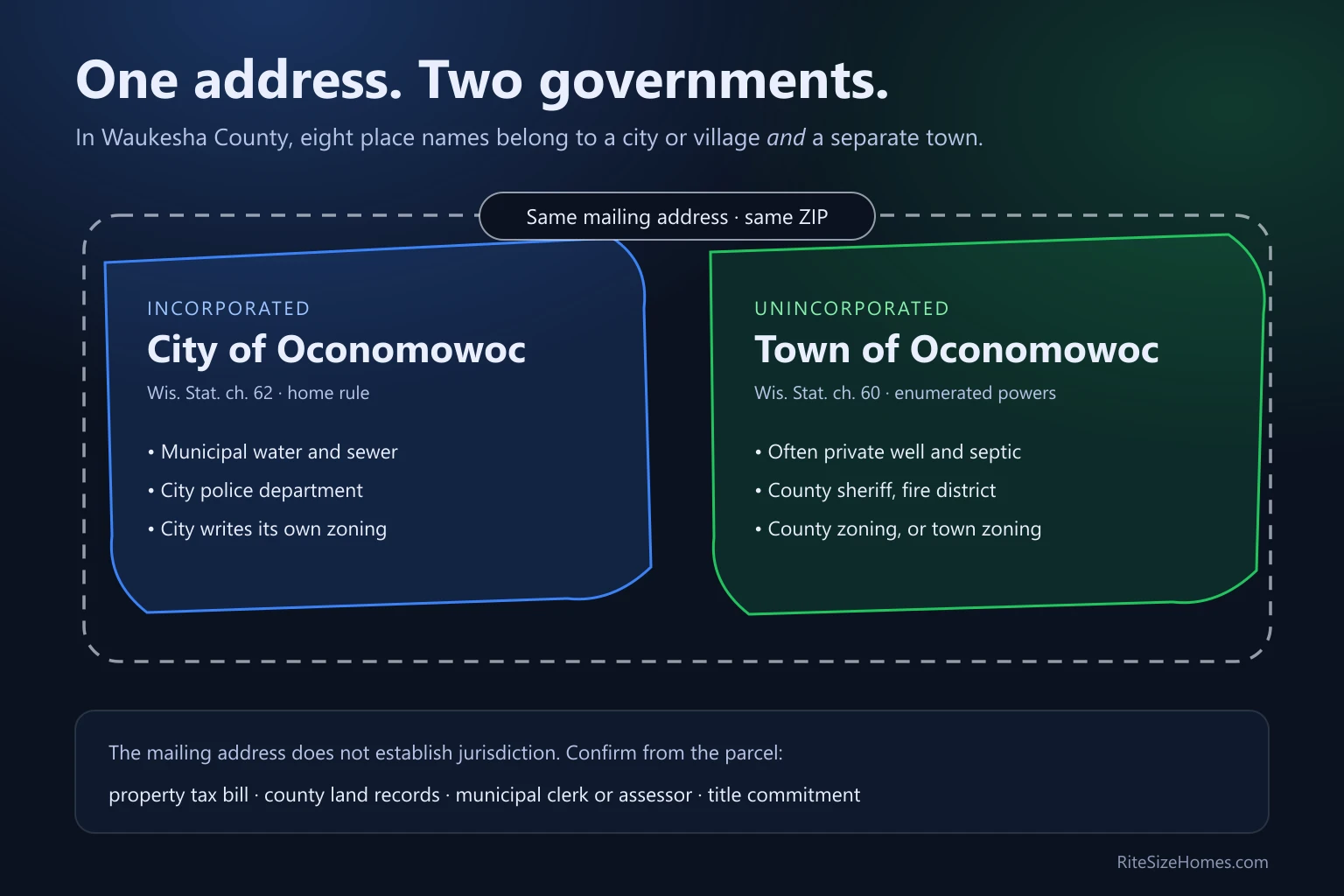
Waukesha County is unusual in how often a single place name covers two separate municipalities. There is a City of Brookfield and a Town of Brookfield. A City of Delafield and a Town of Delafield. A City of Oconomowoc and a Town of Oconomowoc. The same split runs through Eagle and the Town of Eagle, Merton and the Town of Merton, Mukwonago and the Town of Mukwonago, the City of Pewaukee and the Village of Pewaukee, and the City of Waukesha and the Village of Waukesha.
A mailing address does not settle which of those a property is in. Postal delivery boundaries were drawn for mail, not for taxation or land use, and they do not have to match municipal lines. Two homes a few hundred feet apart can share a city name in their address while sitting in different governments with different tax bills, different services, and different rules about what you may build.
This guide explains what actually changes, and how to confirm jurisdiction before it affects your offer. It is a framework for asking better questions, not a substitute for the county, the municipality, and the licensed professionals involved in your transaction.
The distinction is legal, not cosmetic
Wisconsin organizes local government into separate statutory categories. Towns are governed under ch. 60 of the Wisconsin Statutes, villages under ch. 61, and cities under ch. 62. Cities and villages are incorporated and operate with broad home-rule authority over their own affairs. A town is unincorporated and is limited to the functions state law specifically authorizes it to perform.
That difference in authority is the root of nearly everything a buyer notices. It shapes who provides services, who assesses the property, who writes the zoning code, and how much a municipality can change on its own. Wisconsin law also lets a town board be granted “village powers,” which expands what the town may do, so towns are not uniform among themselves either.
What changes on the tax bill
Property assessment in Wisconsin happens at the municipality level, so a city, a village, and a town each run their own assessment and levy. A property tax bill lists the separate taxing jurisdictions that make up the total, which commonly include the municipality, the county, the school district, and a technical college district.
Because the municipal portion and the mix of jurisdictions can differ, comparing two similar homes by purchase price alone can be misleading. Ask for the actual recent tax bill for each specific parcel rather than estimating from a nearby sale or from a county average, and confirm what the bill already reflects in the way of credits.
One related caution: school district boundaries in Wisconsin are drawn independently of municipal boundaries. Being in the Town of Brookfield rather than the City of Brookfield does not by itself tell you which district serves the address. Confirm the attendance area with the district for the exact parcel.
What changes in services and utilities
Cities and villages more often provide municipal water and sewer, their own police department, and direct services such as refuse collection and snow removal. Towns more often rely on arrangements with other units of government or on private systems: law enforcement may come primarily from the county sheriff, fire and emergency medical service may come from a department or district serving several municipalities, and water and wastewater are frequently the owner's responsibility through a private well and an on-site septic system.
These are tendencies, not rules, and they vary parcel by parcel even inside one town. The practical step is to verify for the specific address what is municipal, what is contracted, and what is private, then price the monthly cost accordingly. Where private systems are involved, the inspection and testing work is substantially different from a home on municipal utilities; our guide to buying a Waukesha County home with a private well and septic system covers that in detail.
What changes in zoning and what you may build
This is where buyers are most often surprised, because the authority itself is different. A city or village adopts and administers its own zoning. For towns, Wisconsin law offers more than one path: a town may rely on county zoning, or, where the town board exercises village powers, adopt its own zoning ordinance under the town zoning provisions of ch. 60. Some towns have no general zoning ordinance of their own at all.
There is a further wrinkle that matters in this county. Under s. 60.62, in counties that have a county zoning ordinance, a town generally cannot adopt or amend its own zoning ordinance without county board approval, subject to population-based exceptions and to whether the town has withdrawn from county zoning. The result is that the answer to “who decides what I can build here” is genuinely parcel-specific, and it is worth getting in writing from the county and the municipality rather than inferred.
If your plans depend on a particular use — an addition, an accessory building, a home business, a second driveway, livestock, a short-term rental, splitting a lot — confirm the governing ordinance and the approving body before you waive contingencies, not after.
How to confirm which municipality a parcel is in
Do not rely on the mailing address, the listing headline, or the neighborhood name. Use records that are tied to the parcel:
- The parcel number and the current property tax bill, which name the taxing municipality directly
- Waukesha County's land records and property information system, searched by address or parcel number
- The municipal clerk or assessor for the municipality you believe the parcel is in — a direct confirmation also tells you who to ask about services and ordinances
- The title commitment and the legal description, which describe the parcel rather than its delivery address
When two sources disagree, treat that as an open question rather than a formality. Jurisdiction affects taxes, permitted use, utilities, and which ordinances apply, and those are not things to resolve after closing.
Working it into the transaction
Confirm jurisdiction early enough that it can inform the offer rather than disrupt it. Read the seller's real estate condition report and follow up specifically on utilities, private systems, permits, and any known land-use limitation. Ask the lender whether anything about the jurisdiction, utilities, or acreage affects the loan product, the appraisal, or the timeline. Where private wells, septic systems, outbuildings, or unusual acreage are involved, build the extra inspection and testing time into the deadlines in writing.
None of this makes a town address worse than a city one. Larger lots, lower density, and more latitude in some respects are exactly why many buyers prefer them. The point is that the two are different purchases, and the difference should be a decision you made rather than one you discovered.
If you are weighing more than one of these communities, each has its own page covering local market character and the due diligence that applies there — start from Waukesha County.
This article provides general educational information, not legal, tax, lending, zoning, or financial advice. Municipal boundaries, ordinances, service arrangements, assessments, and statutory requirements change and vary by parcel. Confirm current, property-specific details with Waukesha County, the applicable municipality, and appropriately licensed professionals.