
Racine County buyer guide
Buying a Racine Home With a Lead Service Line
Racine is in the middle of a citywide replacement program, and federal rules are tightening on a known schedule. For a buyer, the question is narrow and answerable: what does this address have, and is it already in the queue?
Two different lead questions come up when buying an older home, and they get conflated constantly. One is lead-based paint, which is about the building and about housing built before 1978. The other is the lead service line — the pipe carrying water from the street into the house. They have different rules, different costs, and different answers. This guide is mostly about the second, with a short note on the first at the end.
If you are looking in the City of Racine, this is unusually worth your attention right now, because the situation is actively changing.
What changed at the federal level
In October 2024 the EPA finalized the Lead and Copper Rule Improvements. The headline requirement is that water systems must replace most lead service lines within ten years. Two dates matter to a buyer trying to understand the local picture: by November 1, 2027 water systems must have a finalized, publicly available replacement plan, and the lead action level drops from 0.015 mg/L to 0.010 mg/L on that same date.
The practical effect is that utilities are no longer deciding whether to deal with lead service lines. They are working to a schedule. That is useful to a buyer, because it means a specific address is increasingly likely to have a known status rather than an unknown one.
What Racine is doing
The City of Racine has a citywide replacement effort underway — reported at roughly $130 million across about five years, targeting an estimated 10,000 lead service lines, with funding from the Wisconsin Department of Natural Resources and the EPA. It also includes replacing a substantial length of aging water main. Public reporting has described roughly 4,000 replacements planned across the 2026–2027 construction season.
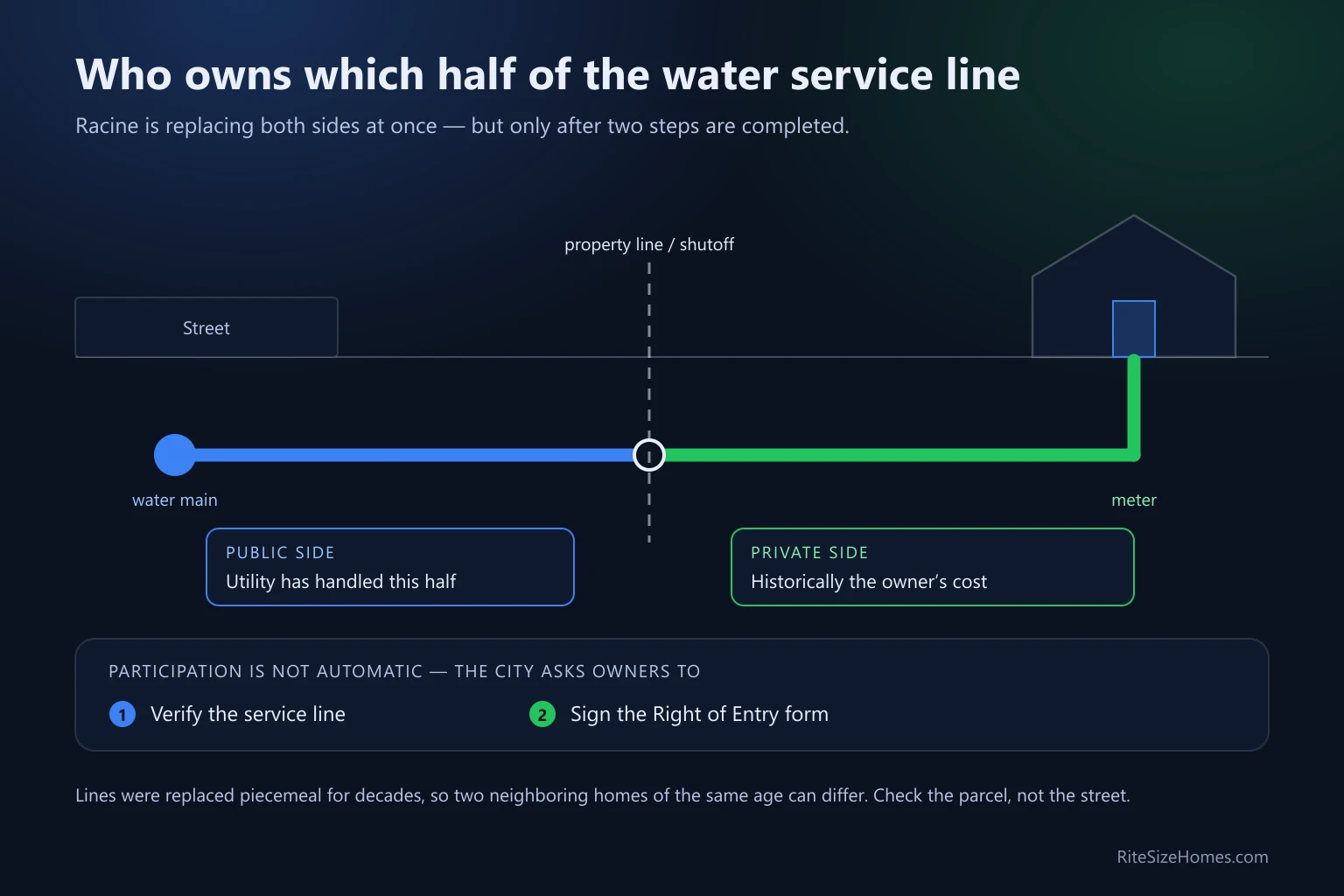
Two features matter most for a transaction. First, the program has been described as carrying no cost to the homeowner for participating properties — which is a meaningful departure from the older model where a private lateral replacement was the owner's expense. Second, participation is not automatic. The city asks owners to complete two steps: verify the service line, and sign a Right of Entry form so crews can do the private-side work.
Confirm current scope, eligibility, and timing directly with the city rather than from this page or from a listing. The program's own site is the authority, and details of this kind change.
Where the line splits, and why it used to matter so much
A residential water service runs from the water main under the street, through a shutoff near the property line, and on into the house to the meter. Historically the utility handled the portion in the right-of-way and the owner was responsible for the private portion on their side. That split is the reason lead laterals lingered for decades: a utility could replace its half while the owner's half stayed in the ground, which can leave lead in the path and, in some circumstances, disturb it.
A program that funds the full replacement, public and private side together, is what removes that problem. It is also why the Right of Entry step exists — the crew needs permission to work on private property.
How to find out what a specific address has
Do not infer from the neighborhood, the age of the house, or what a neighbor says. Service lines were replaced piecemeal over many decades, so two adjacent homes of the same vintage can differ.
- Check the city's service line verification resources for the parcel and ask for the recorded material on both the public and private side
- Ask whether the address is already scheduled in a replacement phase, and for which construction season
- Ask the seller directly whether a Right of Entry form has been signed, and whether any replacement has already been done
- Request any plumbing invoices or permits showing a prior lateral replacement
- Note where the line enters the basement — a plumber or inspector can usually identify the visible material, though the visible end does not establish the whole run
“Unknown” is a common and legitimate answer. Treat it as a question to resolve, not as a defect, and not as proof the line is lead.
Working it into the transaction
Read the seller's real estate condition report and follow up on anything disclosed about plumbing, water quality, or utility work. Then get specific about sequence. If the address is scheduled for replacement after your closing date, you will be the one signing the Right of Entry and scheduling access — which is fine, but it should be a known plan rather than a surprise. If work is scheduled before closing, ask what will be disturbed and when, and what the restoration covers.
Ask your lender and insurer whether anything about the situation affects them. Build realistic time into inspection deadlines if you want a plumber to assess the line, and put any agreement about who signs what, and when, in writing in the offer rather than relying on a conversation.
If you are also weighing water-related risk more broadly in this county, our Racine County flood-risk checklist covers the separate question of drainage and flood exposure.
Outside the City of Racine
This program is the City of Racine's. Other municipalities in the county run their own water utilities or are served differently, and their inventories, timelines, and cost-sharing differ. If you are looking in Mount Pleasant, Caledonia, Sturtevant, Burlington, Union Grove, or Waterford, ask that municipality's utility rather than assuming Racine's answer applies.
And in much of the rest of Racine County — the Town of Norway, Town of Dover, Raymond, Yorkville and similar areas — a property may be on a private well instead, in which case this is the wrong question entirely and the due diligence described in our well and septic guide applies instead.
Lead paint is a separate issue
For housing built before 1978, federal law requires sellers to give buyers the EPA/HUD pamphlet Protect Your Family from Lead in Your Home, to disclose known lead-based paint and hazards, and to provide available records and reports. Buyers also get a 10-day period to conduct a paint inspection or risk assessment, which the parties may agree in writing to shorten or lengthen.
That requirement is about paint, and it applies regardless of what the water service line is made of. A home can have one issue, both, or neither.
In the meantime
If a line is lead or unknown and replacement has not happened yet, ask the utility and a qualified professional about interim steps — these commonly include flushing practices and filters certified for lead reduction. Confirm what is appropriate for the specific property rather than relying on general advice, and have the water tested if you want an actual measurement rather than an assumption.
This article provides general educational information, not legal, health, lending, inspection, or financial advice. Program scope, eligibility, funding, timelines, and regulatory requirements change, and conditions vary by property. Confirm current, address-specific details with the City of Racine Water Utility or the applicable municipal utility, the Wisconsin DNR, and appropriately licensed professionals.