
Walworth County buyer guide
Short-Term Rentals Around Geneva Lake: What to Verify First
A great many Geneva Lake purchases are underwritten, privately, by an assumption about rental income. State law gives that assumption a floor — but three separate layers of rules can still make it wrong for a specific property.
Around Lake Geneva, Fontana-on-Geneva Lake, Williams Bay, and the Town of Linn, it is common for a buyer to run the numbers with some rental income in them. That is a legitimate way to think about a second home. It only becomes a problem when the rental assumption is never actually verified against the property.
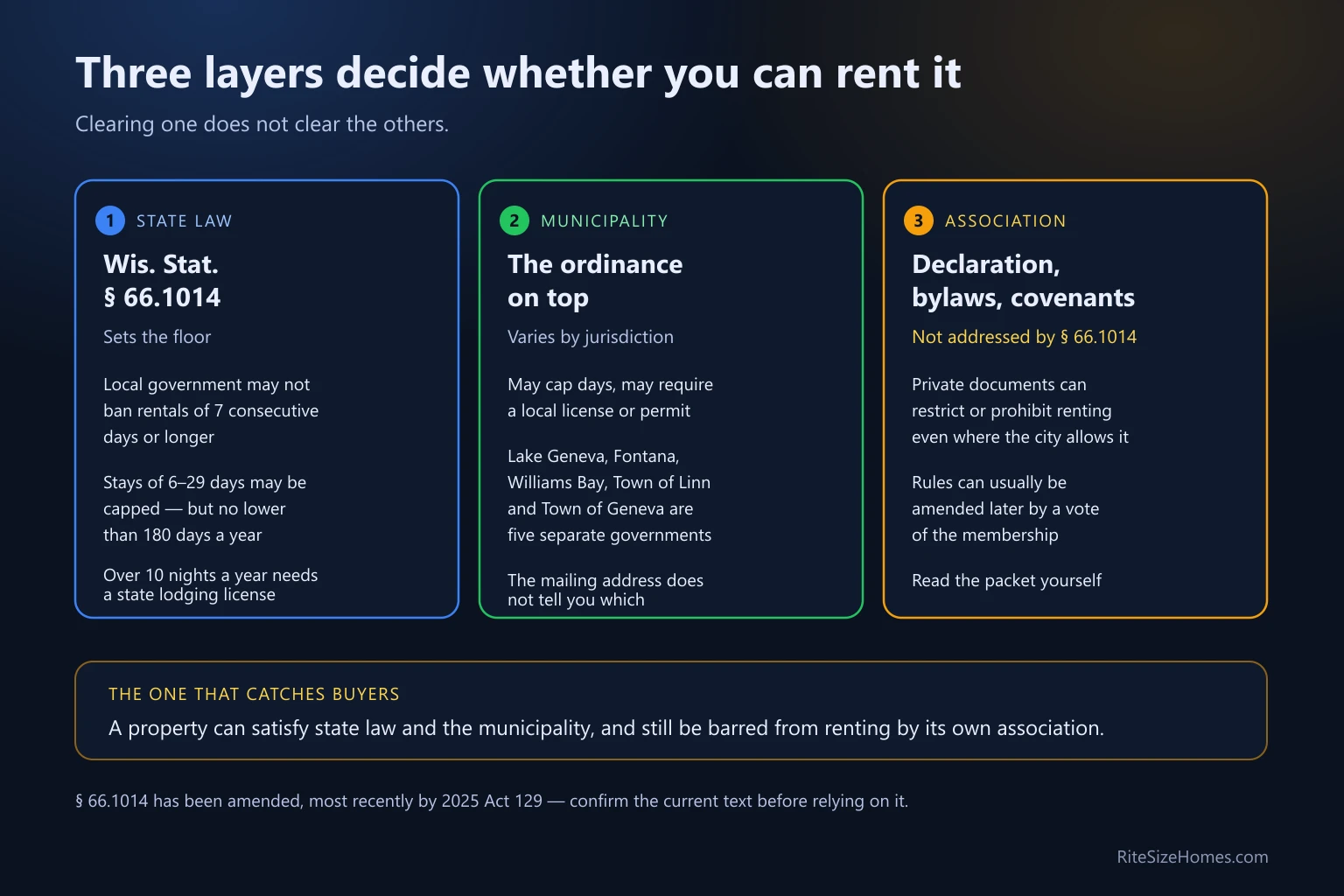
There are three independent layers, and clearing one does not clear the others. A property can satisfy state law, satisfy the municipality, and still be prohibited from renting by its own association documents.
Layer one: what Wisconsin law fixes
Section 66.1014 of the Wisconsin Statutes limits what a political subdivision — a city, village, town, or county — may do. The core provision is that a political subdivision “may not enact or enforce an ordinance that prohibits the rental of a residential dwelling for 7 consecutive days or longer.” That is the floor. A local government cannot simply ban rentals of a week or more.
For shorter stays the statute allows limits. Where a dwelling is rented for periods of more than 6 but fewer than 30 consecutive days, a political subdivision may limit the total number of days within any consecutive 365-day period that the dwelling may be rented — but to no fewer than 180 days. So a municipality may cap it, and the cap cannot drop below 180 days a year.
One note on reading the statute: its history line shows it has been amended several times, most recently by 2025 Act 129. I was not able to establish from public sources exactly what that act changed, so treat the framework above as the shape of the law and confirm the current operative text and any recent case law before relying on it for a specific decision.
Layer two: the municipality you are actually in
State law sets the floor; the municipality writes the ordinance that sits on top of it. Around Geneva Lake that question is genuinely confusing, because the shoreline is divided among several separate governments. The City of Lake Geneva, the Town of Linn, the Town of Geneva, Fontana-on-Geneva Lake, and Williams Bay are each their own jurisdiction with their own rules.
A mailing address does not settle which one a parcel is in. That problem is common enough across southeastern Wisconsin that it has its own guide — see city, village, or town for how to confirm jurisdiction from parcel records rather than from the address.
Confirm with the correct municipality: whether an ordinance exists, whether it caps days, whether a local license or permit is required, and what the application involves.
Licensing is a real requirement, not a formality
The statute addresses licensing directly. A person who maintains, manages, or operates a short-term rental for more than 10 nights each year must obtain a tourist rooming house license from the Department of Agriculture, Trade and Consumer Protection, and must obtain a license from the political subdivision where one is required by ordinance.
State lodging licensing carries a pre-inspection and ongoing compliance with the state lodging code. The administrative rules governing this were rewritten relatively recently, and published fee figures differ noticeably between third-party sources, so I am deliberately not quoting numbers here. Get the current fee schedule, inspection process, and license year directly from DATCP or the county health department acting as its agent.
Layer three: the one state law does not resolve
This is where buyers get caught. Section 66.1014 constrains what governments may do. It contains no language about condominium or homeowners associations, which are private arrangements governed by their own recorded documents.
So a condominium declaration, bylaws, or a subdivision's covenants can restrict or prohibit short-term renting even where the municipality permits it. Around Geneva Lake, where a large share of the inventory is association property, this is not an edge case. If rental use matters to your purchase, read the declaration, bylaws, rules, and any amendments yourself, and confirm whether rules can be changed later by a vote of the membership — because they usually can.
For condominium purchases specifically, the association's documents and finances deserve the same scrutiny as the unit. Our condo document checklist covers how to work through that packet, and the Lake Geneva condo page, Fontana condo page, and Williams Bay condo page cover what shapes value in these particular association markets.
Taxes, financing, and insurance
Short-term lodging in Wisconsin is subject to state sales tax, and county or municipal room taxes may apply on top of it, with registration required with the Department of Revenue. Rental platforms sometimes collect and remit some of these, and sometimes do not. Rates and collection arrangements differ by location and change over time, so confirm the current combined rate and who is responsible for remitting before you build a number into a proforma.
Tell your lender and insurer the truth about intended use early. Financing terms and insurance coverage can differ for a property used as a short-term rental versus a second home used personally, and discovering that at underwriting is far worse than discovering it beforehand.
Make it part of the offer, not an afterthought
If the purchase depends on rental use, treat that like any other material condition. Verify the jurisdiction, the ordinance, the licensing path, and the association documents while you still have contingency time. Ask the seller for any existing licenses, permits, rental history, and correspondence with the municipality or association. Put anything you are relying on in writing rather than in a conversation.
This is also worth separating from the broader water-related due diligence a lakefront purchase needs — access rights, shoreline conditions, piers and private systems are their own subject, covered in our Walworth County waterfront guide. If you are weighing several communities, each has its own page covering local market character; start from Walworth County or compare with Delavan and the Town of Delavan.
This article provides general educational information, not legal, tax, lending, insurance, or financial advice. Statutes, administrative rules, local ordinances, tax rates, and association documents change, and § 66.1014 has been amended, most recently by 2025 Act 129. Requirements vary by property and jurisdiction. Confirm current, property-specific details with the applicable municipality, Walworth County, DATCP, the Wisconsin Department of Revenue, and appropriately licensed professionals.